1941 – 2026
My name is John Howard, and I have been involved in rugby administration for a very, very long time.Nearly all of it has been at the Australian rugby level. I started in school days and, on leaving school, found that I was invited to join quite a number of committees at various levels of the game. I also found time to referee up to first grade standard.
In 1967, I became a member of the council of the Australian Rugby Union, and I remained involved for many years in several different roles. I am a life member of the Australian Rugby Union. I was treasurer and a member of the board for 23 years. I was also involved with Randwick Rugby Club, including as president, and with the New South Wales Rugby Union as chairman. I had a long association with the Australian Schools Rugby Union and was involved with them from their incorporation.
I came into Australian rugby at a time when the game was still amateur, and when amateurism was paramount. That meant organisation was not always what it later became. It fitted into the mood of the time. But myself and others believed rugby in Australia could be built into something much greater.
When I first came onto the scene, Australian teams were often picked and assembled 48 hours before a Test match. We simply did not have the player base that other countries had, and we could not afford to do things casually. Australia is a big country. Players were spread out. If we were going to compete with New Zealand, South Africa, Wales, England and France, we had to organise ourselves properly.
The turning point came after the 1972 tour of New Zealand. Australia lost the third Test 38 points to 3. The New Zealand press had a field day. “Awful Aussies”, “Woeful Wallabies” in the news programs and the front pages of the newspapers. There was even talk that Australia should no longer be regarded as one of the top rugby nations, and that Argentina should take our place.
The Report
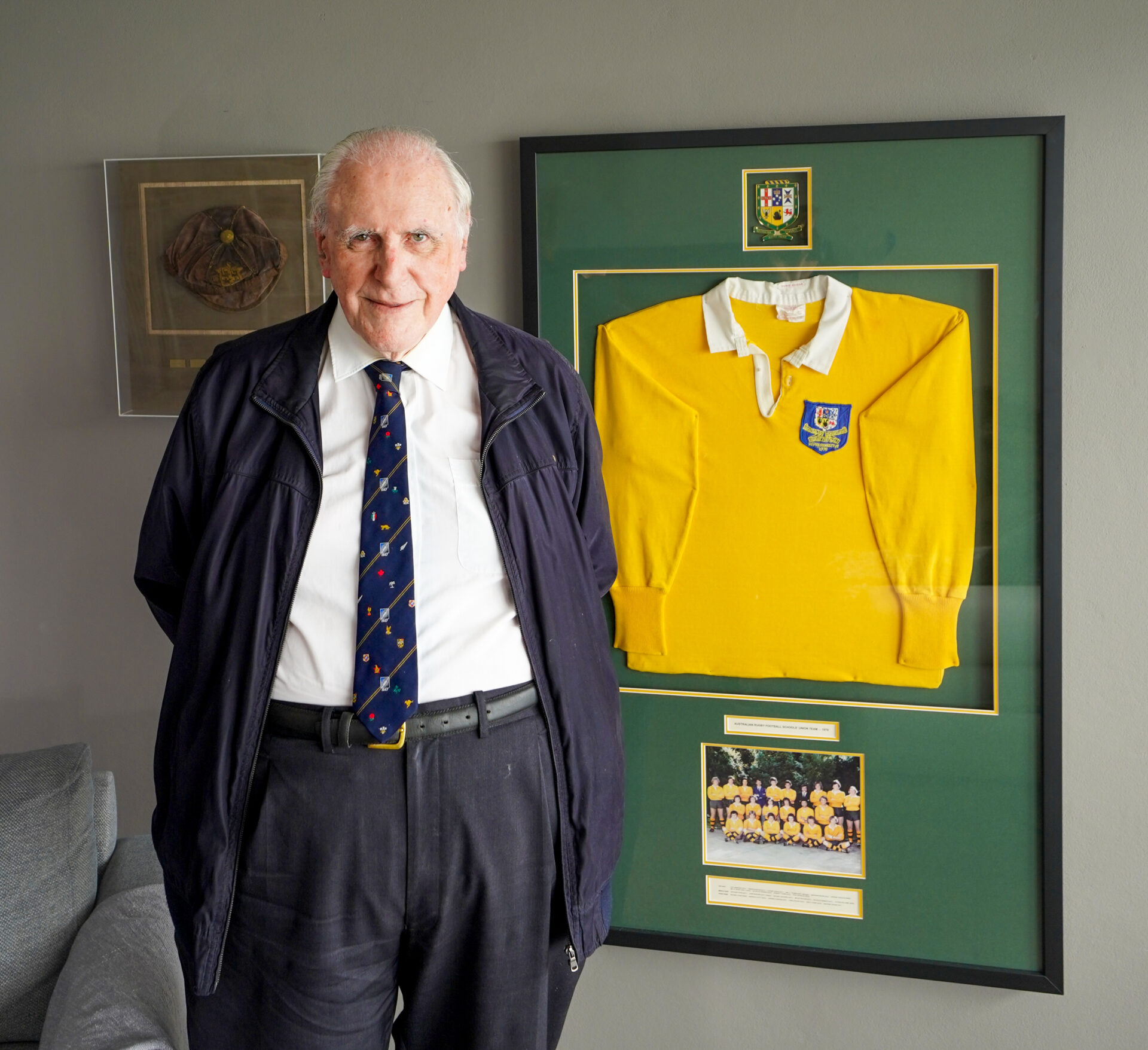
I remember going to a general meeting of the Australian Rugby Union, as a young Turk, and pounding the table, saying we had to do something about it.
The upshot was that I was invited to write a report on rugby in Australia, which took about four months to complete. It was presented to the ARU meeting in February of 1973, and from that meeting, together with others who came on board, we redeveloped Australian rugby up to a level of greatness, towards the end of the 70s and on.
The report was not complicated. It asked three basic questions: what is the standard of rugby in Australia, how can we improve it, and what will it lead to?
I travelled around Australia asking those questions of any group that wished to talk to us. People could say what they thought ought to be done. As that pilgrimage continued, certain areas became clear.
We had to lift rugby at all levels, but our scarce administrative resources needed to be focused on the Australian team. We believed that if Australia was winning, people would want to come and watch. That would generate revenue. The revenue would go into coaching, development and better preparation. And so, it would go on.
Player welfare was important, too. It was still an amateur game, and we were not talking about professional sides, but we wanted the players to feel that the administrators were there with them. We were all working towards the same objective.
Once you start to win, people approach the game differently. Players feel that as much as anyone. They start to win, and then they have a greater interest in continuing to win.
The key elements were practical. First, we had to improve the assembly of the Australian side. The old practice of bringing a team together only a couple of days before a Test match was not good enough. Second, the manager and coach had to be appointed at the start of the season, so they could settle in, involve the key Australian players and make them feel part of the organisation.
We also realised that when a team went overseas and returned, valuable information was being lost. Players had learned about scrummaging, different styles, and different approaches, but no one was capturing that knowledge. So we began assembling teams after their tours to discuss what they had learned.
Another important step was to have more representative football. Players needed more games. The number one choice in a position had to fight to keep his place, and the up-and-coming player had to be able to challenge him. Queensland led in this area because they were already beginning to develop that kind of structure themselves.
Coaching was another major issue. We were fortunate that the Rothmans National Sports Foundation had been formed to provide coaching support across Australian sport. They offered us the opportunity to appoint a full-time coaching director. That was Dick Marks from Queensland, who had represented Australia.
Dick had the time and the responsibility to build programmes, consult coaches and managers, and help develop the game. In April 1974, with some financial assistance, we brought Ray Williams out from Wales. Ray was an outstanding coaching director and had achieved considerable success in Britain. He toured Australia for three weeks, and people came to listen to him everywhere. It was not only what he said about rugby, but his enthusiasm and approach. Dick Marks travelled with him around Australia, and that helped ignite people.
Then, to start building up programs and consulting with coaches and managers to see how best we could actually go. Therefore, as we developed these lines, we started winning more games at home, more people came, and we had more revenue. Every bit of revenue that we ever had was turned straight back into more coaching, more development, more teams that needed support in different ways, more games if necessary. We developed an Under 21 structure where players who had looked pretty good coming out of school were able to play Australia versus New Zealand, mainly, and New South Wales versus Queensland. One of the things that we noticed early in the piece was that if a young player aged 19 or 20, who might have been a star in his own school, but he suddenly came on and was pitted against South Africa or New Zealand, he spent half the game just getting connected to what was going on and then after that, therefore his performance could not be as good as he might have liked. We were looking for stepping stones.
The stepping stones were, firstly, the development of the school’s area. The second was that, when you left school, apart from the club and a lower-level representative area, by the time you came on and were selected for Australia, you were at least used to the atmosphere of the arena.
Things developed on a considerable scale.
It did not all change overnight. A report is not presented on Friday, and then, by Saturday, you are winning all your games. In 1973, we had the misfortune of losing to Tonga in a two-Test series. That caused great woe and much shredding of clothing, as you can imagine. But the developments were there.
By 1974, we played New Zealand in a three-Test series and lost the first Test only 6-3. Two years earlier, we had lost 38-3. In 1975, England came to Australia, and we beat them in two Tests. We beat Japan as well. There were still difficult moments, including against France, but by 1979, we beat New Zealand at the Sydney Cricket Ground in a one-off Bledisloe Cup match. In 1980, we beat New Zealand two Tests to one in a three-Test series.
From there, Australian rugby moved forward.
Schools, Randwick and the Australian Way
At the same time, schools rugby was also developing. In 1969, the first Australian Schools team was invited to tour South Africa, playing seven matches, winning six. That invitation came from Danie Craven to Charles Blunt at an international board meeting, and South Africa paid the expenses. The success of that tour helped galvanise the development of state schools unions and, more importantly, the Australian Schools Rugby Union.
In 1973, an Australian Schools team toured the United Kingdom and won all but one game. That heightened public interest at a time when rugby in Australia was at quite a low level. Then, in 1977, the Australian Schoolboys went even better. They were undefeated on tour and won all three Test matches against England, Ireland and Wales. Scotland pulled out at the last moment. It was not just that they were undefeated; it was the running style of rugby they played that captured the UK audience’s attention. They scored 553 points for and only 97 against across 16 matches, scoring 110 tries while conceding only 6.
The development of transport also played a part. It became cheaper for teams to assemble in one capital city. Before that, the cost and time involved were prohibitive. In 1957, for example, the New South Wales team travelled to Queensland by overnight train. That was not so long ago in the scale of things, but it shows how difficult it had been.
There were many people involved in developing schools rugby. Jim Lucey in Queensland was one. Jika Travers in New South Wales was another. Jika had played for England while at Oxford and was a prominent headmaster at Shore. He gave strong support to the formation of the New South Wales Schools Union.
Once state schools teams could play each other, you could select Australian Schoolboys sides because the talent was in front of you.
One of the great things about Australian rugby from October 1972 onwards was that everybody supported each other. It was not only the people leading Australian rugby. It was the states, the adult teams, the schools, everyone. Once you begin to get a flow of better players coming through, it is essential that the Australian school system maintains its ability to produce players of that standard. It did that, and it is still doing it fifty years later.
I always felt there was a strong rapport in Australia between the schools and the senior game. I was treasurer of the Australian Rugby Union and assisted the Australian schools movement from its early days. That meant what was happening in schools could be fed through to the Australian Rugby Union. The schools felt they had the support of the national body, and the players felt part of an Australian network. A band of brothers is not too strong a phrase. Everybody worked together.
In 1977, I refereed the famous final of the Australian Schoolboys Championships trials between New South Wales I and New South Wales II. The twos beat the ones 6-3. I had refereed a lot of first grade rugby by then, and that schoolboys game required as much attention as a normal first grade adult match. The quality stood out immediately. You could tell this was an exceptional group, even before they went away.
The 1977 team had wonderful players. The Ella brothers, Mark, Glen and Gary, were outstanding. So were many others who would go on to become part of the Wallaby teams of the 1980s. Their manager was Brother Bob Wallace, and the coach was Geoff Mould, a teacher at Matraville Boys High School. Matraville had been exceptional. It was a co-educational school with limited numbers in Years 11 and 12, yet they had beaten St Joseph’s College convincingly in a friendly and won the Waratah Shield the previous two years. Geoff also had a connection with Randwick Rugby Club, whose ethos was to run the ball, not stupidly, but to run the ball and look for opportunities. He took that philosophy away with the team, and the boys responded.
Randwick itself was a special club. I was president of Randwick and had been closely involved there for many years. The club played a style of rugby based on movement, skill and confidence. The attitude was that if you scored tries against Randwick, Randwick would score more against you.
That was the essence of it. Keep the ball moving, sensibly, not irresponsibly. Tire the opposition. Back your skill. Play rugby that players enjoyed and spectators enjoyed. That kind of rugby attracted good players, and when you attract good players, you win more games. Eventually, when you run onto the field, you expect to win. Confidence is half the battle in any sport.
One of the great Randwick occasions was the match against the New Zealand All Blacks at Coogee Oval, which was won by the All Blacks 25-9 in what many say was one of the best games of rugby ever played in Sydney. New Zealand did not really want to play a club side out of a stadium, but I organised the game. It was such a success that the gates at Coogee Oval were shut 20 minutes before the game. There are photographs of people standing on roofs and up streets, trying to watch. It was quite something.
The World Cup, Professionalism and a Life of Service
Professionalism later changed rugby, but the game had been moving in that direction for a long time. The official start of professional rugby is usually dated to the mid-1990s. I stepped down from the Australian Rugby Union the year before professionalism became legal. It was not because I disliked professionalism. I had been on the board for 23 years. It was time to go.
Even before professionalism, we had recognised that players could not continue to give their time without support. In Australia, hidden professionalism was not as great as in Britain or France because we did not have the money. But as more revenue came in, we tried to meet players’ basic expenses. If they had costs related to being away from Australia, such as healthcare, a car payment or a mortgage, we endeavoured to help meet them. We saw it not as professionalism, but as subsistence.
The question of professionalism became a major concern in 1982, when a private group sought to establish a professional rugby union competition worldwide. They canvassed players. I always believed it would not have succeeded, though not everyone agrees with me. I did not think the organisation or crowds would match what they expected.
But it did convince people such as Sir Nicholas Shehadie that the Rugby World Cup should come sooner rather than later. He felt there was money around through television and sponsorship that had not existed 20 years earlier, and that rugby should direct its own future rather than have it forced upon it by an outside group.
The credit for the Rugby World Cup must go to Sir Nicholas Shehadie. He believed the time had come. He sensed New Zealand was also making noises about something similar, so he invited New Zealand to join us. We formed a joint committee, three from Australia and three from New Zealand. I became the treasurer of that committee.
We approached the International Rugby Football Board to request permission to conduct a feasibility study. Permission was granted, but there was great opposition, particularly from Wales, Ireland and Scotland. They did not believe the World Cup should exist.
When the proposal eventually went to the board, the decision was very close. England and Wales split. Scotland and Ireland voted against. South Africa, though isolated from world rugby at that time, supported it. France supported it. It passed by one vote.
The British unions were largely opposed to the idea and thought we would fail. We did not. The first Rugby World Cup in 1987 was a success. The players loved it. Four years later, when the tournament was held in Britain in 1991, it was such a success that some in Britain seemed to think they had originated the concept.
When I look back on matches, certain memories remain vivid. One was Australia against New Zealand in Auckland in 1978, when Australia won 30-16, with Greg Cornelsen scoring four tries. It was not just the score; it was the style of play, the way Australia took on a very good New Zealand side. Being there was a great joy.
The best player I ever saw was Ken Catchpole, the Randwick and Wallaby halfback. Even after watching rugby for 50 or 60 years, I still think he was the best. He could assess a situation in a split second and turn nothing into something. He was modest, instinctive and brilliant.
I also remember England playing against Wales in 1981. England won 9-8. The match itself was close all the way, but what I remember most was the atmosphere, 75,000 people, Welsh and English in equal measure, singing and urging their teams on.
Australian rugby has never had a huge reservoir of players. Even when rugby was number one or number two in Australia, we did not have the base that some other countries had. Rugby league has always been strong. Australian Rules is strong. New Zealand, although smaller in population, can focus its best players into rugby. We have always had to use our scarce resources wisely.
I think at times we lacked direction at the management level. Perhaps we did not always keep pace with other countries as they applied professional skills to training and development. Sometimes decisions are made too much in the interests of television, when the better approach is to make decisions in the interests of the sport and then work out how television fits.
I was fortunate throughout my life in rugby. People asked me to join different levels of the game, and those opportunities built on each other. I enjoyed doing it.
One of the great things about amateur officials was that many of them were highly qualified in their own fields. Sir Nicholas Shehadie was also Lord Mayor of Sydney. Dr Vanderfield was a senior health administrator. These people brought dedication, experience and judgement to rugby. Sometimes, people who are paid salaries do not look at the results of what they are doing as closely as volunteers do. That is not only true of rugby. It happens everywhere.
I had my own business as an accountant, and rugby was honorary work. It often meant getting into the office very early in the morning to do rugby work before doing my paid work. But it was satisfying. People had faith in me. They asked me to do things, and I was lucky that many of them worked.
One of the great satisfactions of the 1980s and 1990s was that when Australia played at home, we would generally win three out of every four matches. Spectators came to a game feeling reasonably confident Australia would win. The players had that same confidence. It was a golden age.
It has been a most satisfying life.
By John Howard OAM, with Anthony Edgar
Note from the editor:
This article began as an interview to gather background material for the history of the ASRU and the beginnings of the Australian Schoolboys.
The interview was conducted at John’s office in Bondi Junction on 2 December 2020, before we moved to my home to finish the conversation and take a few photographs. John was uniquely qualified to speak on this history, having been deeply involved with both the ARU and Schools rugby, and he seemed to know all the players of the day.
Given the short turnaround, normal fact-checking, including the spelling of all names and dates, has not yet been completed. Please feel free to advise if any corrections are required. The priority today was to publish this in John’s memory.
On a personal note, the world would be a better place with more people like John Howard. His spirit of service and sacrifice was one of the finest I have ever encountered. He epitomised the rugby ethos.
Anthony Edgar